And yet I still believe in humanity...!
And yet I keep believing in humanity…
About history, equality, and what we pass on.
With horror, I watched the two-part Zembla documentary about neo-Nazi groups and their networks. It made me nauseous, sad, and, frankly, also frightened.
Not because I am naive about what is happening in our world. But because I once again wondered how it is possible that we, with everything history has taught us, are still willing to deny each other our humanity.
We commemorate, teach, and speak about freedom and equality. We say "never again." But what do those words mean when it truly matters?
Do we only recognize history when it has already become history?
History travels with us
As a woman with Indonesian-Dutch roots, I carry with me a family history in which origin, uprootedness, and starting over play an important role. Stories from the Dutch East Indies, about a past that still continues to shape generations later.
Take the word repatriation, for example. Returning to one's homeland. But what if, for many people, that homeland was not the country they were born and raised in?
Words can describe reality, but they can also conceal it.
Perhaps it is precisely that history that makes me sensitive to the way we categorize people. By origin, faith, skin color, culture, or conviction.
Equality is not a given for me. I know that in reality it is far from always there.
And yet I believe in it.
What disturbed me about the documentary was not only the ideology, but also how such beliefs can move within our society. Behind seemingly ordinary faces, in closed circles, and sometimes from social positions.
And let's not think for a moment that this only happens in the Netherlands. All over the world there are extremist movements that, each from their own ideology, exclude people or deny their rights and dignity.
We have more knowledge and opportunities to meet one another than ever before. And yet we keep finding ways to create distance between people.
How can that be?
Especially when children grow up with such ideas, it deeply affects me. Because what we model for our children, what we tell them, and what we keep silent about, helps shape how they see the world.
What do we actually pass on?
Not from power, but from movement
For many years I have worked with people of different ages, backgrounds and cultures. As an artist, a maker, a mentor, but above all as a human being.
I have seen what happens when someone is given room to discover themselves. When we don't judge right away, but listen. When we don't prescribe what someone should think, but kindle curiosity.
Sometimes change begins with something very small. A conversation, an encounter, a creative process. Someone who suddenly looks at themselves or at another person in a different way.
I believe in that.
Not power over people, but the ability to set something in motion.
I don't need to be in the foreground. What matters to me is what I can mean through my actions.
But I certainly don't want to give the impression that I always know how things should be done. Far from it!
I make mistakes, sometimes judge too quickly, am headstrong, can be stubborn, and sometimes react out of emotion. I have disappointed people, and I am disappointed in myself. And no doubt there have been times I did not truly see or understand someone.
I too carry prejudices with me; I increasingly catch myself doing it.
But I want to keep recognizing them. To dare to question myself and to be able to admit when I have seen something wrongly.
How can I believe that others can change if I exempt myself from that?
My experiences give me insights, but not automatically the truth.
And perhaps that is exactly what troubles me about beliefs in which there seems to be no longer any room for doubt, self-examination, or the human being in front of you.
By the way, for me equality does not mean that I have to accept every belief. Every person deserves human dignity, but not every belief deserves my agreement. Certainly not when it denies the freedom and dignity of others.
After all, seeking connection doesn't mean we have to go along with everything.
What are we sowing for tomorrow?
As I write these words, I realize something special.
On 24 and 25 April 2027, I will exhibit together with other female artists from the INDY Collective in Eindhoven. Our exhibition is titled SEMAI, Indonesian for seedlings.
From our Indies, Indonesian and Moluccan roots, we are exploring what our ancestors have left us. Stories, memories, history, and everything that, consciously or unconsciously, is passed down from generation to generation.
And suddenly that touches on exactly the same question the documentary raised for me.
What are we actually sowing?
Which beliefs do we allow to take root? Which stories do we pass on? And what grows from that for the generations that come after us?
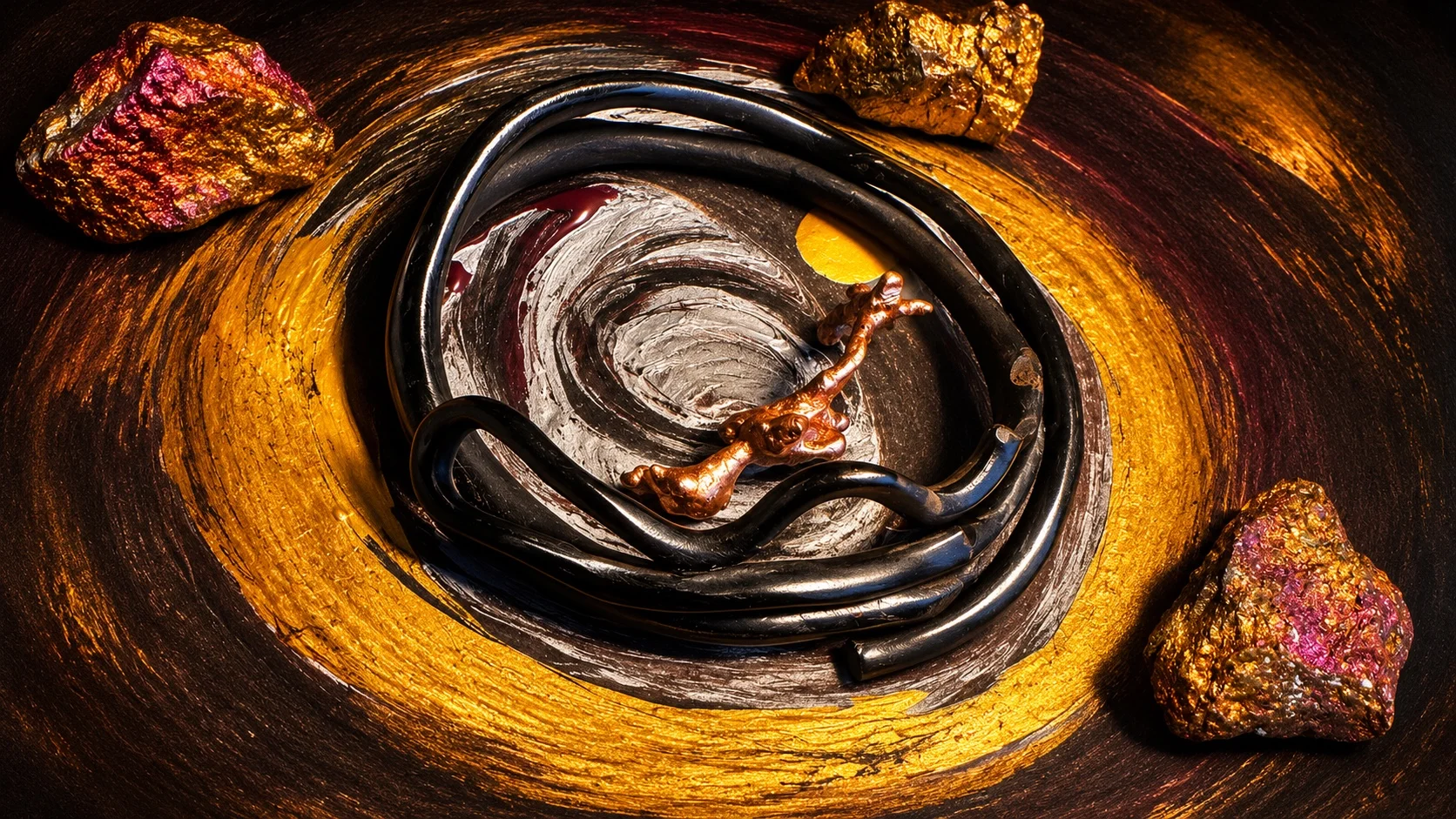
In my own artwork I use, among other things, black akar bahar, copper, and a golden circle. Materials and shapes that, for me, refer to origin, connection, and movement.
A cycle can keep repeating itself. But we can also choose to break a pattern.
Perhaps that is what keeps me occupied as an artist. Not only exploring where we come from, but also the direction we ourselves give to our history.
And yet…
While watching, I asked myself whether I should write about this. Or whether I would be better off keeping my mouth shut. After all, there are already so many voices, so many opinions.
What does mine add?
But what happens when we all think our voice doesn't matter?
When we stay silent because something is complicated, look away because it becomes uncomfortable, or expect someone else to take action?
My opinion doesn't matter, my insight does.
That insight has been shaped by my life, my family history, encounters, mistakes, and everything I have been privileged to learn along the way.
The documentary did not shake my belief in change. On the contrary. It reminded me why I have spent so many years trying to connect people, make room for other perspectives, and keep encouraging curiosity.
Not because I think love and understanding solve everything. But because indifference certainly doesn't.
We cannot change history. We can, however, decide what we do with its lessons.
I am still worried. Maybe even more than before.
But I want to keep believing in humanity. Not because history always gives me reason to, but because I do not want that history to determine our future.
Perhaps change doesn't begin with the question of what someone else should do differently.
But with a question for ourselves:
What am I contributing today to the world I hope to leave behind tomorrow?
Ismene x