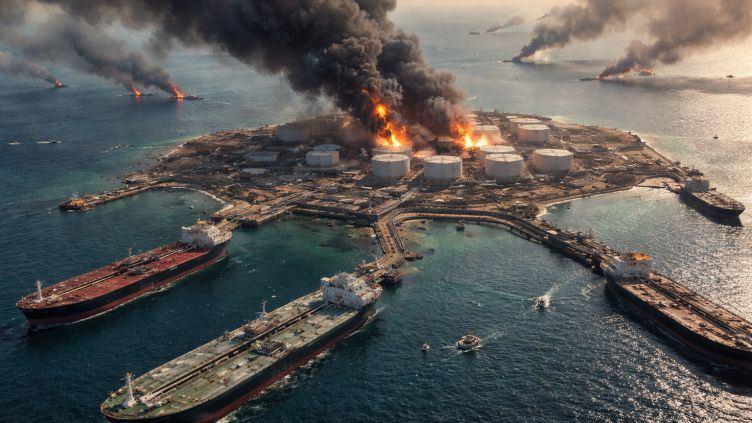
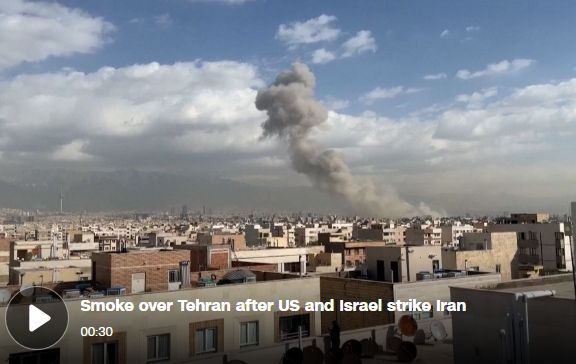
The strike on Iran’s Kharg Island, even if it only has been a clearly military action against Iranian military assets, needs to be seen as a profound turning point in the unfolding Middle East conflict. Until now the confrontation has been largely confined to missile exchanges, proxy operations and regional signaling, hitting Iran’s military and IRGC assets. That phase is now over. The targeting of Kharg Island shows that the conflict has moved directly into the heart of the global energy system. These developments should now be seen as a clear sign that the world is entering Phase II of the war: a confrontation centered on oil infrastructure, maritime chokepoints, and the arteries of global trade.
To make clear, Iran’s Kharg Island is not just another offshore installation, but the single most important node in Iran’s oil export architecture. As it located around 25 kilometers offshore the Iranian coast in the northern Persian Gulf, it has been set up and functions as the most pivotal terminal point for Iran’s main crude oil pipelines. It also is the most strategically located loading hub for most of the country’s seaborne exports. Even under the last years sanctions conditions, Iran has been able to export between 1.2 and 1.7 million bpd. Almost all of these volumes have been done through Kharg’s vast storage and loading facilities. It also has a storage capacity of close to 18 million barrels of oil, with its terminals being able to accommodate some of the world’s largest crude carriers.
Until now the strikes have been targeting military infrastructure on the island, not yet the oil facilities themselves. This seems to be a preparation of possible, in the next days or weeks, US attacks by marine forces, as around 2500 US Marines are sailing towards the region as reported. Information at present shows that radar installations, air defence systems, aviation infrastructure and naval facilities have been hit. Even without targeting its oil infrastructure, the strategic message is clear: Iran’s oil lifeline is now within military reach.
This is changing the total strategic calculus of the conflict. The moment that Kharg Island pops up as a target in the battlefield, this will mean that every tanker loading there becomes part of the war’s risk equation. Insurance markets, shipowners, and traders understand this, and will react with a vengeance. Energy infrastructure does not have to be destroyed to disrupt global markets; it only has to become unsafe.
Kharg Island and the Vulnerability of Iran’s Oil Exports
To understand the real picture it is necessary to address certain fundamentals. Iran’s geography leaves it deeply exposed in any energy conflict. In contrast to the UAE and Saudi Arabia, Iran has not been able or willing to invested heavily in pipelines that bypass the Strait of Hormuz. Tehran remains dependent on Gulf export terminals, of which Kharg Island handles the overwhelming majority. Main clients served here are Asian buyers such as China.
Damaging Kharg, especially if seriously or making it inoperable, Iran will be looking at immediate and severe consequences. Within days, if even possible at present, export capacity will be down, hitting almost nil, while the country’s financial impact would be devastating. For global markets, the situation would be dramatic too, as they would lose a significant stream of discounted crude. Asian refiners have been relying, even right now, on them.
Yet the broader significance of the attack is not only linked to Iranian export volumes. The fallout of this is that the market is going to look at energy warfare, in which infrastructure, ports and shipping lanes will become really active and strategic targets.
The Strait of Hormuz: Already Under Pressure
The Kharg escalation comes at a precarious moment, as maritime traffic through the Strait of Hormuz is already deteriorating rapidly. The results of Kharg, and Iran’s reaction will put the situation in the strait to a boiling point. The situation in the Strait has been assessed by all already, as tanker movements through the strait have dropped sharply, while a long list of tankers and other vessels is anchoring inside and outside of the Gulf arena. Satellite tracking and maritime intelligence reports indicate that tanker traffic has not only fallen dramatically, but the situation in the Sea of Oman is also very volatile.
At times more than 150 tankers have been observed anchored outside the strait, all refusing to enter the conflict zone. Insurance premiums have spiked, while shipowners are looking at a situation where the financial risk of operating in the region now outweighs the potential rewards. This means in reality that one of the most important arteries of the global energy system is already paralyzed.
The Red Sea: A Second Chokepoint Under Threat. Theatre 2.0?
Analysts and policymakers also should be looking at another maritime corridor the next hours and days. The Red Sea and the Bab El-Mandeb Strait could become critical very soon.
As the Red Sea is the main gateway between the Indian Ocean and the Mediterranean via the Suez Canal, it carries normally roughly 12 to 15 percent of global trade. For Europe in particular the corridor remains essential for energy and industrial supply chains, which range from products, fertilizers, chemicals to cars, chips, and automotive.
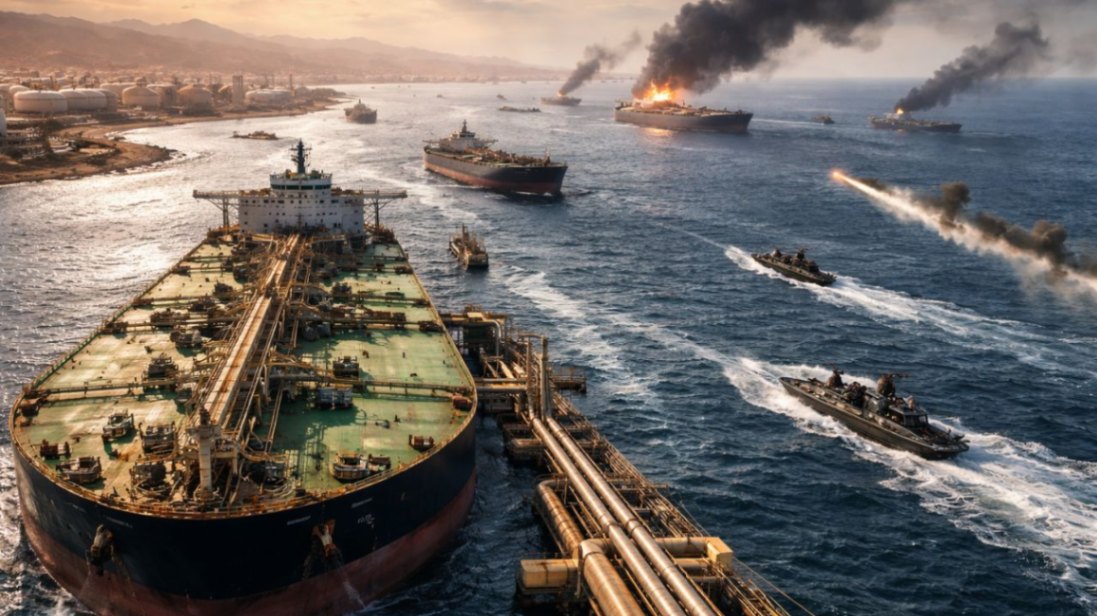
Looking at the ensuing developments it needs to be expected that Yemen’s Houthi movement will enter the conflict. This not only raises the specter of a second maritime crisis but will also threaten the already very volatile shipping sector. The last years, the Houthis have already demonstrated their ability to disrupt shipping. The use of drones, missiles and sea-borne attack craft has been optimized by these non-state actors, forcing shipping companies to reroute vessels around the Cape of Good Hope, adding weeks to global supply chains.
Available data shows that the Red Sea still hosts hundreds of commercial vessels at any given moment. Vessel tracking indicates that this is typically between 200 and 300 ships depending on traffic patterns and rerouting decisions. The ship volumes are made up of bulk carriers, container vessels, product tankers, and occasionally large crude carriers transiting between the Mediterranean and the Indian Ocean. Saudi Arabia the last days has been chartering a long list of VLCCs to enter the arena to load available Aramco volumes and products. Houthi actions could result in stranding a large volume of them inside another confined arena for a long period of time. Although the number of VLCCs in the Red Sea at any one moment is usually limited, the corridor remains crucial for the movement of refined products, petrochemicals, and LNG cargoes, especially for Aramco.
In a situation that the Houthis escalate operations in coordination with Iran, shipping will be hit dramatically, with a tsunami of consequences for energy markets and others. Without any doubt, the Red Sea can rapidly transform into a second contested maritime zone. In that case, the global energy system will be facing a never experienced pressure from two directions.
The Nightmare Scenario: Two Energy Arteries Cut Simultaneously
The last years energy markets have considered the possibility of a disruption in the Strait of Hormuz. Until now, most scenarios have not modelled a simultaneous disruption of both Hormuz and the Red Sea corridor. This will lead to an immense logistical shock to the global energy system.
The Strait of Hormuz normally carries roughly 20 million bpd of oil and petroleum products. The Red Sea and Suez corridor are logistical arteries to move an estimated 7 to 10 million bpd of oil and refined fuels. Both are also pivotal for significant volumes of LNG and petrochemicals.
A situation in which there is simultaneous disruption will force vessels to reroute around the Cape of Good Hope. Freight costs would surge, while tanker availability is tightening immediately. Severe strains will be put on supply chains.
Market reactions will be powerful, even with a partial disruption. Markets will need to expect charter rates for crude carriers to spike even more.
The Hidden Vulnerability: Refined Fuels and Petrochemicals
Crude oil is dominating headlines, but there is another, maybe even more pivotal crisis hiding. The real vulnerability in a maritime energy crisis often lies in refined fuels and petrochemical supply chains. Until now, the Gulf region has been the world’s largest export hub for products such as diesel, jet fuel, naphtha, LPG, and petrochemical feedstocks. Asian refineries and chemical sectors depend heavily on Gulf-sourced inputs. Europe at the same time imports critical volumes of refined fuels via both Hormuz and the Suez route. The collapse of tanker traffic will hit global industrial systems, as airlines jet fuel supplies will tighten, feedstock availability for fertilizer producers will be cut, while plastics manufacturing and chemical industries would feel the pressure almost immediately. Clear message, downstream industries will be destabilized.
The Strategic Geography of Escalation
An increased number of signs also signal that there are even more potential flashpoints targeted, even closer to entrance of the Strait of Hormuz itself. Attention should be put on the situation around the Greater and Lesser Tunb islands and Abu Musa, which are current controlled and occupied by Iran. The UAE has historical claims on them, as they sit directly along the shipping routes used by tankers entering and exiting the Gulf.
Without any doubt, these islands, hosting Iranian military installations, entailing missile batteries, radar facilities and IRGC naval units, make them a high military priority. For Iran, their location makes them strategically invaluable for monitoring or controlling shipping in the strait.
When the conflict intensifies, as we see now, these islands are central battlegrounds. If Iran will start to use them as operation bases, US-Israel could strike them. Any military action, however, also will put the UAE under pressure and will increase the risk of regional escalation.
Tehran has repeatedly warned that regional infrastructure will be targeted if the conflict expand. The first signs of this are seen, such as Fujairah. Ports, oil terminals, desalination facilities, and energy installations across the Gulf are at present part of the conflict landscape.
Shipping, Insurance, and the Self-Imposed Blockade
Shipping markets normally react quicker than governments in a modern maritime conflict, as we see right now. War-risk insurance premiums are spiking again. Meanwhile reports of GPS interference and AIS spoofing in the Gulf show the complication of navigation and raise additional safety concerns. Due to all of this, shipowners will choose simply to stay away. The result is a self-imposed maritime blockade.
Phase II of the War
The attack on Kharg Island signals that the conflict has entered a new strategic phase.
Phase I has been characterized by missile exchanges, drone strikes and proxy confrontations across the region. The new situation or Phase II is different, as it focuses directly on energy infrastructure, maritime logistics and global supply chains.
A Houthi escalation in the Red Sea while the Hormuz situation escalates, will mean a situation in which the two most critical maritime energy corridors are simultaneously under threat. This is the most severe disruption to global energy shipping, even worse than the tanker wars (Iran-Iraq War) of the 1980s.
Oil prices, which have surged already above the psychologically important $100 per barrel threshold, could be spiking as soon as markets reopen on Monday. Still, the deeper danger is not price spikes, but the possible fragmentation of the global energy logistics system itself.
Until 2026 stability of international energy markets has depended on the free flow of oil through a handful of maritime chokepoints. These now are becoming battlefields (even that when looking at Ukraine-Russia some could say this partially already was there), which will be felt far beyond the Middle East.
The attack on Kharg Island will not be remembered as just another military escalation, but the first step of the war moving into the infrastructure that powers the global economy.