When did LinkedIn stop being “the world’s largest professional network
Source : Alessio Di Ciero
We read this quit often !


Von der Leyen’s ‘Shield for Democracy’ Sparks Fresh Controversy — and a Clash with Elon Musk; UK Economy Slides Further
It was only a matter of time before Ursula von der Leyen returned to the center of attention.
This week, the European Commission unveiled her long-trailed “Shield for Democracy”—a package aimed at countering disinformation and foreign interference.
While some critics say the plan threatens fundamental freedoms, parties such as D66 and VVD argue it doesn’t go nearly far enough. Elon Musk also jumped into the debate, launching a pointed attack on the Commission President.
Across the North Sea, meanwhile, the economic news from the United Kingdom continues to worsen. What exactly is going wrong?
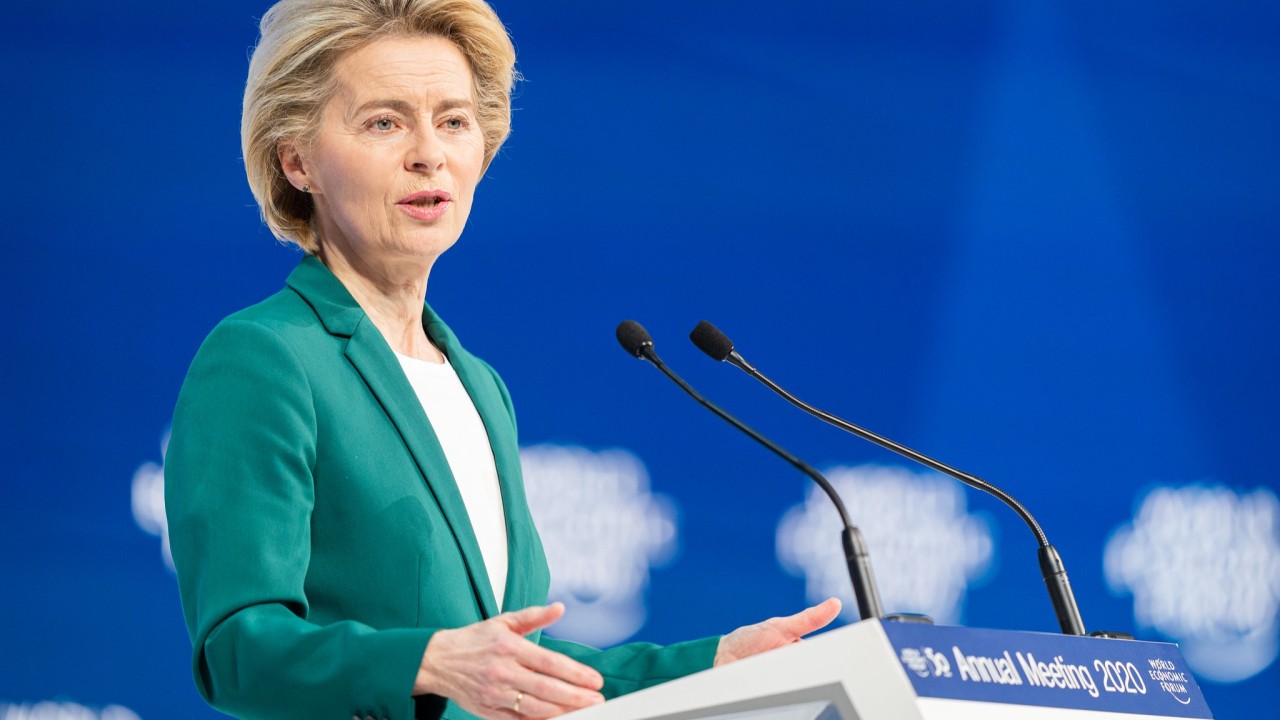
Von der Leyen’s Shield
Back in September, we reported that von der Leyen was working on a “European Democracy Shield” designed to combat misinformation and disinformation.
This week, the Commission officially presented the plan, outlining strategies to confront foreign interference and the manipulation of information.
According to the Commission, Europe’s democracies face mounting internal and external pressure, and authoritarian regimes view them as threats—responding with increasingly aggressive tactics.
Brussels claims these regimes aim to sow division, foster distrust, and undermine free and fair elections.
Key elements of the plan include a European Centre for Democratic Resilience, intended as a hub for detecting and responding to disinformation, and an EU-wide fact-checking network
tasked with designating what information should be considered trustworthy. The EU also intends to provide financial support to “independent” journalists and media outlets. In addition, Brussels
is introducing a European citizenship framework, signalling a more direct role in shaping civic education in schools.
Von der Leyen presents the initiative as a measure to safeguard democracy, prosperity, freedom, and security—everything Europe cherishes, she argues, against hostile authoritarian actors.
But not everyone agrees. Social media erupted with concerns about censorship, with critics pointing to other EU ambitions—digital IDs, a CBDC, Chat Control, an EU-wide driver’s licence, and
even a European intelligence service—as evidence of a drift toward centralised control. Many fear the plan could create a system in which only approved narratives on issues such as climate, security and migration are permitted.
Musk vs. von der Leyen
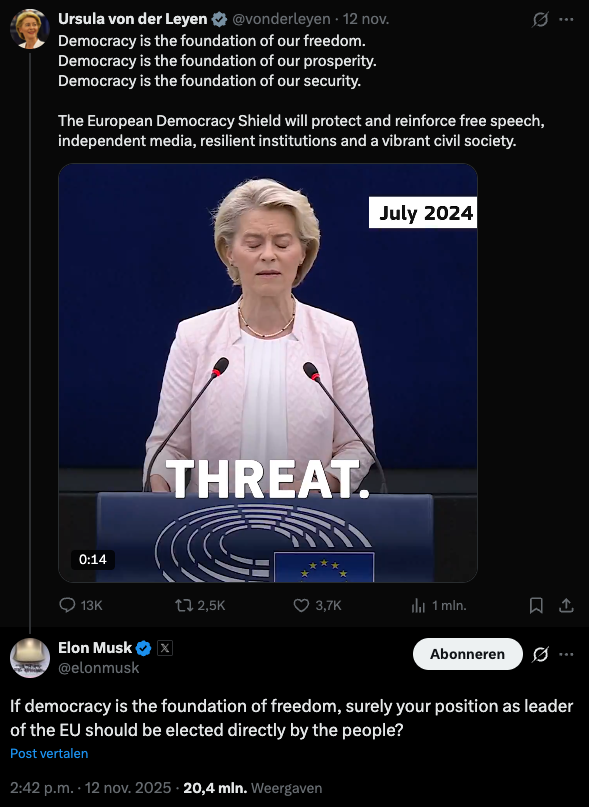
Elon Musk weighed in as well, delivering a sharp critique of both European democracy and von der Leyen herself, who increasingly presents herself as the de facto leader of Europe.
“If democracy is the foundation of freedom, shouldn’t the leader of the EU be directly elected by the people?” Musk wrote on X, adding that Europe’s “leader” should be chosen by citizens,
not appointed by a “committee.” His comments gained significant traction on his own platform.
Musk and the EU have long been at odds over the Digital Services Act. The Commission has even singled out X as the platform on which disinformation remains most persistent.
Inside the European Parliament, reactions are deeply divided. Patriots for Europe, the group that includes the Dutch PVV, argues: “Brussels’ new ‘Democracy
Shield’ protects the Commission and its proxies—not democracy and not citizens. By centralising power and silencing dissent, the EU risks undermining precisely the freedoms it claims to defend.”
Renew Europe, which includes D66 and VVD, takes the opposite view. The group strongly supports von der Leyen’s plan—but says it falls short. It is calling for “far more
ambitious legislative action,” arguing that Europe must move from rhetoric to enforceable measures capable of countering “growing threats to democracy.” The group will now push to strengthen von der Leyen’s proposal.
UK Economy Under Strain
Trouble isn’t confined to the EU. The British economy shrank by 0.1 percent in September—an unexpected contraction. Across the entire third quarter, growth amounted to just 0.1 percent. We previously
reported on an exodus of wealthy Londoners, widening budget deficits, rising interest rates, and tax hikes that appear to be backfiring. Lately, almost no positive economic news has come from across the Channel.
The contraction wasn’t the only disappointment. Unemployment rose to 5 percent, with wage growth slowing. That’s the highest non-pandemic jobless rate in a decade and higher than economists’ forecasts.
New data show the UK has lost 180,000 jobs since Chancellor Rachel Reeves announced higher employer taxes in the previous budget. Business confidence took a hit after she raised payroll taxes by £25 billion.
The figures are a major setback for Reeves, particularly as she is expected to announce fresh tax increases soon to plug an estimated £30 billion budget shortfall. According to the Financial Times,
the stalled labour market reflects fears of further tax hikes, while the government’s plans to expand worker rights make hiring more risky for employers.
Reeves responded to the grim numbers by saying that “there is more work to do to build an economy that works for working people.” Critics argue the rising joblessness is the direct result of
her decisions to increase labour taxes and burden companies with additional regulation.
Exodus of Entrepreneurs Accelerates
Meanwhile, the exodus of entrepreneurs and wealthy Britons continues. The latest to depart is tech entrepreneur Herman Narula, who is relocating to Dubai—the same destination
chosen by the founder of Revolut, whom we previously covered. Narula blames what he calls the government’s anti-business climate, which he says is driving innovative companies out of the country.
There is growing speculation that Reeves is preparing to introduce a capital-gains exit tax for wealthy individuals leaving the UK. A letter signed by hundreds of entrepreneurs and investors warns that such a tax “tells founders not only that their ideas and innovations aren’t welcome here, but that they should leave early—or avoid coming altogether.”
The UK has already lost 11,300 millionaires in the past year. A poll by the Adam Smith Institute shows that 28 percent of Britons aged 18 to 30 are considering emigrating.
For those interested in the British debate, podcast maker Peter McCormack delivered a scathing monologue this week, accusing the government—Reeves in particular—of economic illiteracy. In his view, Westminster lacks even a basic understanding of money, inflation, markets, and economics.
We’ll continue to follow Reeves’s next moves closely.
We'll send you a nice letter once per week. No spam.