The fall-out of the Russian invasion of Ukraine, and the increased threats of Russian (Chinese) interference in Europe, are clear, but somehow not yet fully understood.
While the Baltic members of NATO, and Scandinavia (Norway, Sweden, Finland, Denmark) have put their military awareness levels on Red, looking at the continuing hybrid
warfare operations of Moscow, Europe’s mainland countries, including the UK, are still assessing via a bureaucratic system how to deal with a potential crisis.
Even though hundreds of unknown drones are flying around, data cables and pipelines are being attacked offshore, or airports are closed down, the urgency seems to be still in the hands of others.
While not forgetting Poland, one of Europe’s only war-ready member countries, the rest are lagging, relying partly on the well-known American security cover. Still, things
are changing, as the potential for a confrontation with Russia (and its allies) is no longer far-fetched, leaving no other option but to reconsider and assess our current security capabilities.
For some, logistics is always about trucks driving on the highways of Germany, the Netherlands, or Belgium, and it is key when an enemy or threat needs to be addressed or repelled.
Where NW European ports are continuously assessed as major logistical hubs for the continent, addressing the defense or security of ports, railways, airports, and even highways feels, for some, worrying or even not functional.
At present, NATO has already addressed the role of NW European logistical infrastructure in a future conflict, warning of a lack of investment, new construction, or even the expansion of existing infrastructure.
Europe’s own Union, the EU, has only just woken up. The time to act is clear: Brussels will present its new strategy on November 19, with full-scale emphasis on defense, security, and logistics.
It is not only a timely piece but also will be very interesting for maritime, road, and rail infrastructure partners to be part of the implementation, as it will entail a multibillion euro program, focusing on
NW Europe, entailing major overhauls of Dutch, German, Belgian, and Baltic/Polish ports, railroads, and highways.
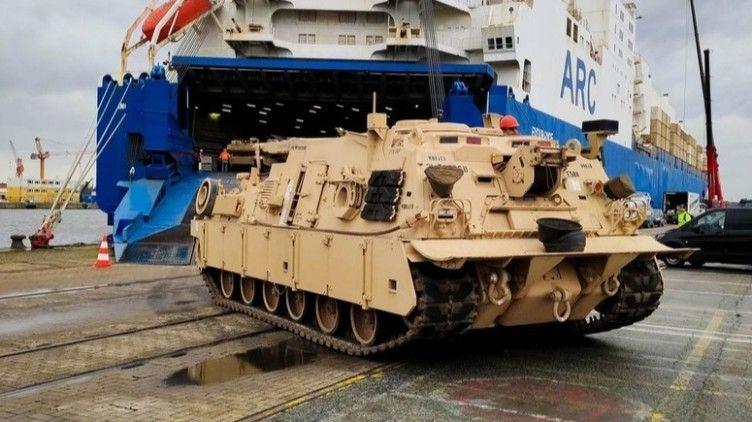
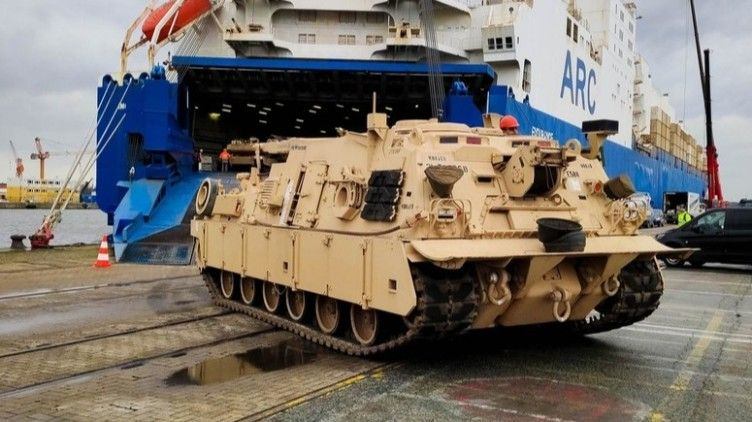
Europe’s logistical spine, which is not the NW European–Italian highway and railway route, but from the Baltic ports and Rail Baltica down through Germany’s rail-road nodes to the ARA hub (Amsterdam-Rotterdam-Antwerp, a key logistical hub), needs to be revamped and strengthened to become future and war-proof. At present, as military advisors, NATO experts, and logistical experts have stated, it is not fit to surge heavy forces, ammo, fuel, and spares at the speed a real crisis with Russia would demand. Even though NATO used military hardware to counter and crush a perceived attack, its mobility issue — bringing hardware from outside Europe (the USA, Canada, the UK) — is, at present, a strategic weak point. Every military strategist and advisor will agree that speed and mobility will be key to success.
In a move to address these pending or even threatening issues, Brussels’ military-mobility package due around 19 November aims to close that gap with a shared “solidarity pool” of transport assets, hardening bridges and tunnels on four EU-NATO priority corridors, and slashing border red tape. However, to really become practical and valuable, the priorities are already clear.
The Baltic- Rotterdam axis will need to be elevated to become a single strategic logistics axis. At the same time, there is a need to fuse civilian and defence operators under a single playbook and to fund dual-use upgrades at a scale that matches the threat. In contrast to the situation of the last decades, the latter no longer needs to follow budget cycles, as they would constrain all.
As stated before, Europe/NATO can't set up a strategy to try to win slowly. Looking at the Eastern Flank threats, NATO needs high-intensity, multi-domain operations that require moving heavy armor, bridging units, air-defence batteries, fuel bladders, ammunition trains, and repair echelons east quickly, while also being able to sustain these operations for weeks. In statements made by the EU’s transport chief, the latter has openly stated that Europe’s roads, bridges, and railways are not yet up to the job. In conventional warfare scenarios, the current situation is severely constraining NATO operations. Weight limits and weak bridges would slow tanks, trains by non-standard loading gauges and scarce sidings, and convoys by customs formalities that still look like peacetime. To address these issues and push for a future-proof approach, the European Commission’s emerging plan proposes €17 billion in upgrades across around 500 projects and a regulatory drive to cut border delays. First assessments show that the direction is correct, but the current baseline is sobering or worrying.
While the new proposals may bring about significant changes, there are several positive and innovative ideas within them:
· Pooling of lift assets (heavy trucks, low-loaders, ferries, and rail wagons), meaning that if one country (Poland) has a shortage during a crisis, across borders, others will be providing them on known terms and conditions.
· Simplification of funding and regulations, based on four priority corridors, co-designed with NATO, which includes the North Sea–Baltic axis. The latter ties Rotterdam/Antwerp to Germany’s inland hubs and to Poland and the Baltics.
· Border and customs streamlining toward a de facto “EU military-mobility area by 2027”
· Bigger money in the next MFF via the Connecting Europe Facility (CEF), which means finances for military-mobility proposals would be increased to €17.7 bn (2028–2034)
For the Rotterdam – Baltic arc, the EU package recognizes for the first time the following:
· The ports of Rotterdam and Antwerp are crucial, as they connect oceanic sealift to continental road/railroad. If not militarized (procedurally/physically), Germany-Poland/Baltic is not reachable in a crisis.
· At the same time, the Baltics are the end effectors, as without Rail Baltica, all heavy equipment must be swapped or transloaded during transport.
At present, the NW European-Baltic situation is dire, or, in a military assessment, even threatening. Without taking a full-scale assessment approach, it is clear that bridges and tunnels, at present, are failing to meet MLC (military load class) requirements for modern armor; convoy spacing rules extend move times. There is also a lack of rail freight geometry, meaning that logistical operations are hindered or blocked by a shortage of loading gauges, axle-load limits, and long sidings. The latter is of utmost importance in the case of 740-metre trains, which are now unable to move assets as needed. When looking at available ports in the area, it is clear that not all Baltic or North Sea berths have roll-on/roll-off capacity for heavy armor, OPS (onshore power supply) power for ships at berth (for secure mission-critical servicing), or secure marshaling yards with enough turning circles for tracked vehicles. All also agree that there is a heavy administrative drag (customs/permits), while funding and governance are fuzzy at present. As some stated, all is based on small pots, scattered projects, and slow execution.
In all plans and strategies, only one corridor really matters in a time of war: the Baltic-Rotterdam Corridor. A central Concept of Operations (CONOPS) would be based on a surge from the ARA area to the Gdansk–Gdynia–Kaliningrad perimeter and Tallinn/Riga/Klaipėda. It would hold:
- Sea entry at ARA. Pre-designated defence priority berths; 24/7 customs/immigration teams; secure staging yards integrated with rail nodes (Kijfhoek, Maasvlakte) and inland waterway push-tow flots for fuel and bridging.
- Rail main effort via North Sea–Baltic corridor: Standardized loading points, pre-approved train paths with time windows, 740-m sidings every 50–80 km, and heavy-axle allowances to move armor without breaking consists.
- Road as surge overflow and last-mile: MLC-rated bridge lists published to military; oversize corridors with escort priority; corridor-wide green lanes at borders.
- Baltic reception: RO-RO-capable quays, rail-to-road transship, and fuel/ammo storage dispersed and hardened; Rail Baltica standard-gauge used for both military and relief logistics. europarl.europa.eu+1
The above could be achieved through dual-use investments involving CEF-Transport and defense financial lines. The total should also be based on predictable rules (EU/NATO).
The need for all is clear; now it's time for implementation. Asset solidarity should be put in place, based on a legally sound EU-level leasing/requisition framework for rail wagons, low-loaders and ferries, with compensation tariffs, insurance, and operator obligations defined up-front. At the same time, emphasis and funding should be placed on corridor master schedules, including five-year build lists (bridges, tunnels, sidings) with compressible milestones, so member states and NATO logistics can plan force packages against real capacity. Without any doubt, after dealing with bureaucracy and legislation, there should be money that matches physics; the €17.7 bn CEF-military mobility line should be pushed without delay.
For Rotterdam (ARA), it is both an opportunity and a challenge. The port and its hinterland need to move from being only a big (Europe’s largest) port to becoming a functional and strategically important war hub. The latter is achievable, as the Netherlands already chairs an EU PESCO (Permanent Structured Cooperation in Defence) military mobility project, while running a national plan to develop logistics hubs and corridors for NATO/EU movements. The Port of Rotterdam can convert this into a genuine war-hub, by committing to three things:
· defence-priority windows at key berths and rail yards.
· a standing “jump team” with customs, police, port authority, and rail manager to process convoys; and
· dual-use upgrades (OPS, RO-RO, secure marshalling, cyber-hardening) co-funded via CEF/defence lines.
The latter is a win-win situation not only for the Port of Rotterdam but also for the Dutch economy and NW Europe. Taking this approach as a dual-use strategy not only strengthens the military logistics component needed but also supports ongoing port expansion and diversification plans. Improved logistics is, without a doubt, a significant win for any port.
At the same time, possible opposition to all can be rebuked. The EU's new strategy on November 19 is not a duplication of any NATO operation or investment. As NATO only plans forces, the EU controls the rules, funding, and much of the infrastructure. The joint workstreams already exist (ten progress reports, structured dialogue). As the European Parliament and Commission have stated before, the corridors are co-designed with NATO; duplication is a choice, not a law of nature.
Funding is also not going to be an issue. At present, the EU spends €300 bn on defence in one year; the current mobility fund is €1.7 bn, which is a drop in the ocean. By putting in place an €17–18 bn rail-road-port push that also multiplies civilian capacity (freight punctuality, axle load, sidings), a new deterrence and industrial policy is being set up.
On November 19, the only question we should ask is: “Is Europe able to turn a patchwork into a war-ready corridor”? If money, contracts, and feasible milestones are being delivered, the answer could be surprisingly YES. Key points in all will be:
· Will Rotterdam-Antwerp be configured as a defense gateway?
· Will Germany and Poland be sufficiently funded to deliver the rail infrastructure requirements at scale?
· Will there be a solidarity pool, so that hardware and military assets can be moved within hours?
Are there no more border issues?